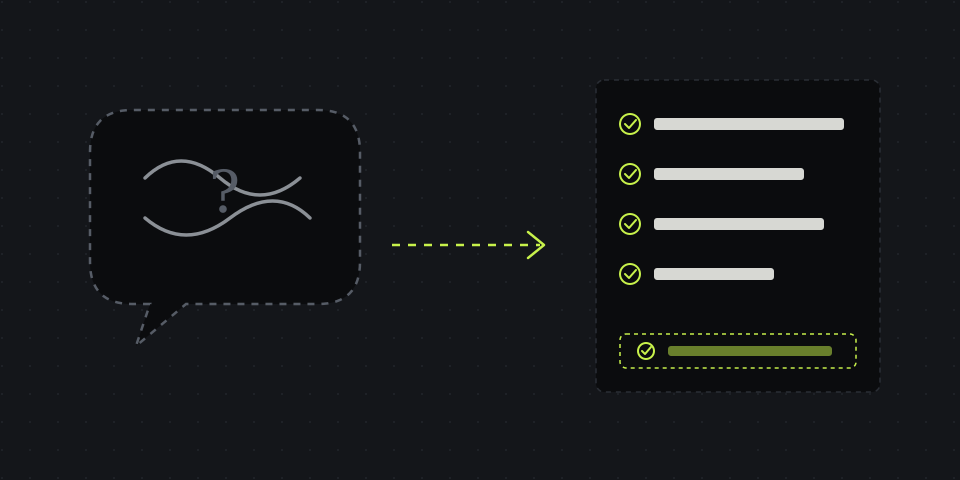
Three reasons a written task falls short
Most tasks that come back with clarifying questions suffer from the same three problems. Fix these and the number of follow-up calls drops sharply.
1. No context — why it matters
"Lower the price on this item" is technically a complete instruction. But the person executing it doesn't know if it's a one-off promo, a reaction to a competitor, or a pricing error being fixed. Without context, they either ask, or — worse — guess and do the wrong thing.
2. No "done" criteria
A task like "fix the button design" has no end state. Fixed it — now what, send it for approval? Wait for feedback? Publish right away? Without a clear "done when," the person executing decides for themselves when to stop, and that rarely matches what the requester had in mind.
3. No example or visual
Text conveys logic well but appearance poorly. "Make the button more noticeable" can be done a dozen ways, and none is guaranteed to be the one you meant. A screenshot with the area circled settles it in a second.
A task formula that skips the follow-up questions
A working structure is four parts. Not bureaucracy — a habit that eventually takes seconds:
- What — a specific action, not vague verbs like "improve" or "optimize."
- Why — one sentence on the reason. This gives the person room to make their own call if the literal version turns out to be awkward.
- Done when — a measurable, or at least verifiable, result.
- Attached — a screenshot, a link, an example — anything that shows instead of tells.
Before and after
"Please fix the button on the checkout page"
That's not a task, it's a hint at one. Compare it with the version built on the formula:
What: Increase the size of the "Pay" button on the mobile checkout page.
Why: Analytics show 30% of mobile users tap next to the button — visible on the click heatmap.
Done when: The button is at least 44px tall, shown to me as a preview before publishing.
Attached: A screenshot of the heatmap and an example from a competitor's app that gets this right.
The second version is longer to write but shorter overall — no clarifying question, no call, no "wait, is this really what you meant?"
Voice gets there faster than text
The catch with the formula is that writing out all four parts takes two or three minutes — which is exactly why it gets skipped when people are in a hurry. The fastest way to hit every part is to say the task out loud, the way you'd explain it to a teammate in person: the "what," the "why," and the done-criteria come out naturally, because that's how people explain things when speaking.
That's the idea behind voice → task in DashShot: record a voice note, and AI breaks it down into a structured task using this same formula — with a deadline, success criteria, and an attached screenshot if you took one. You don't have to remember the structure, just that you're explaining something to someone.